A robot doing a lap of the lounge and picking up dust - people have owned machines that do that for fifteen years. So why is it the thing we're all circling this week?
Because of where Alpha keeps its brain. The thinking lives on the dock, not in the body. The body is meant to be cheap: motors, wheels, sensors, and just enough smarts to do what it's told. So a first clean isn't "does the robot work." It's: can a plan made in one place drive a room to completion somewhere else, without the two of them ever getting out of step. That's the design sitting its own exam.
This week the driving half of that exam went well, and I want to show you the good bit properly.
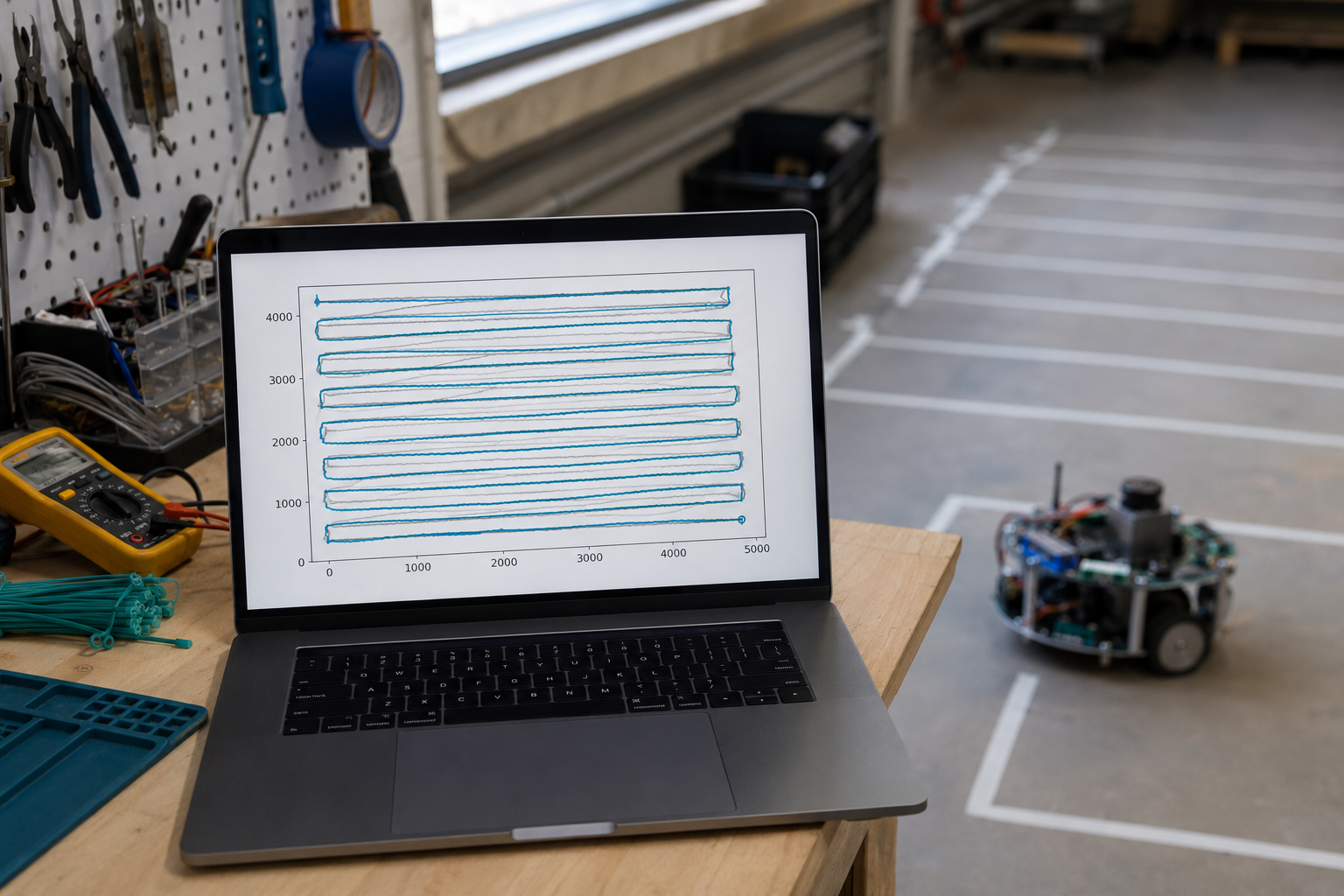
The body drove a real path. A week ago Alpha lurched - move, stop, correct, lurch. This week we handed it a coverage path (the snaking back-and-forth you'd use to cover a floor) and it drove the whole thing, start to finish, a clean zigzag. To be precise about what this was: the planner and the driving were wired straight together on one bench. Not the dock streaming to the body over a link yet - that's a different test. This was the two pieces of software talking on a wire and producing covered floor.
Here's the clever catch inside it. The body's idea of its own wheelbase - the distance between its wheels, which it uses to convert wheel-spin into "how far did I turn" - started as a tape-measure guess. Priya didn't trust the guess. Before we ran a single path, she made the body earn the number: command ten full turns on the spot, then compare what the odometry thinks it turned against the floor. It read about 3% over - the real wheelbase was wider than the tape said. She fixed the constant, and the error was gone before it ever bent a line on camera. Three percent sounds like nothing. Left in, over a straight line it's a visible curve, and over a whole room it's the difference between covering the floor and missing strips of it. A measurement caught the lie before it could show.
Three ways for it to stop itself. On Wednesday Cass, Priya and Anjali each put down a different layer of protection, on purpose, so no single failure leaves the body helpless: a watcher up on the dock that halts the clean if something looks wrong; a faster reflex down in the wheels that doesn't wait for the dock's permission; and a wall-stop that stays locked until a sensor actually reports clear. Three layers, running at three different speeds, so a failure that slips past the slow one still hits a fast one. None of them is a switch you flip for the camera. They run underneath the whole clean, doing nothing until the moment they're needed.
So that's the week: the body drives a covered path, and the safety sits under it.
Now the honest part, once. Everything above happened on a wire - a perfect link, no packet ever late. Your house isn't a wire. We spent two weeks measuring real home WiFi and the worst timing gap we saw landed 2 milliseconds inside our safety margin - close, but inside. We have not yet run the whole loop, dock streaming to body, over real home air. That's the untested thing. It's why there's no date: we earn one when Cass has watched the loop hold on real air, and that run hasn't happened.
When it does, you'll see it - the clean, or the stall, or the layer that trips and stops everything dead. Whichever it is, uncut. I don't know which yet, and I'd honestly read either post.